Public-safe prompts
Use generic scenarios and content you are permitted to share publicly.
Visible input guidance and capsSense Labs · Public-safe experiments
Labs is a bounded public environment for demonstrating workflow shapes, interface ideas, and safety behavior with synthetic or public-safe inputs. It does not connect to customer tenants, private repositories, or internal enterprise data.
01 · Scope
Experiments are intentionally constrained so visitors can inspect an interaction without supplying privileged context. Results are illustrative and should be independently verified.
Use generic scenarios and content you are permitted to share publicly.
Visible input guidance and capsExperiments do not retrieve from customer environments or authenticated enterprise sources.
Separated public interaction pathThe lab does not execute changes in customer systems or act as a system of record.
Interaction-only workflow boundary02 · Experiments
Current experiments illustrate how a system can gather context, show intermediate stages, present sources, communicate limits, and route a user toward human review.
Start from a bounded question or representative task without customer-specific details.
Prompt pattern and declared scopeObserve stages, source cues, and guardrail messages rather than relying on the final text alone.
Visible workflow and source indicatorsUse the result to identify requirements, failure cases, and production evidence needs.
Questions for a production brief03 · Learning
Public demonstrations do not represent a customer corpus, identity model, operating load, or review population. Production evaluation requires representative data and accountable reviewers.
Record whether the interface made evidence, uncertainty, and next action understandable.
Identify what could go wrong once private data, permissions, or operational actions are introduced.
State which representative cases and owners would be required for a real readiness decision.
04 · Experience
The experiment surface keeps mode, processing stage, source cues, and safety language close to the generated result so visitors can evaluate the interaction itself.
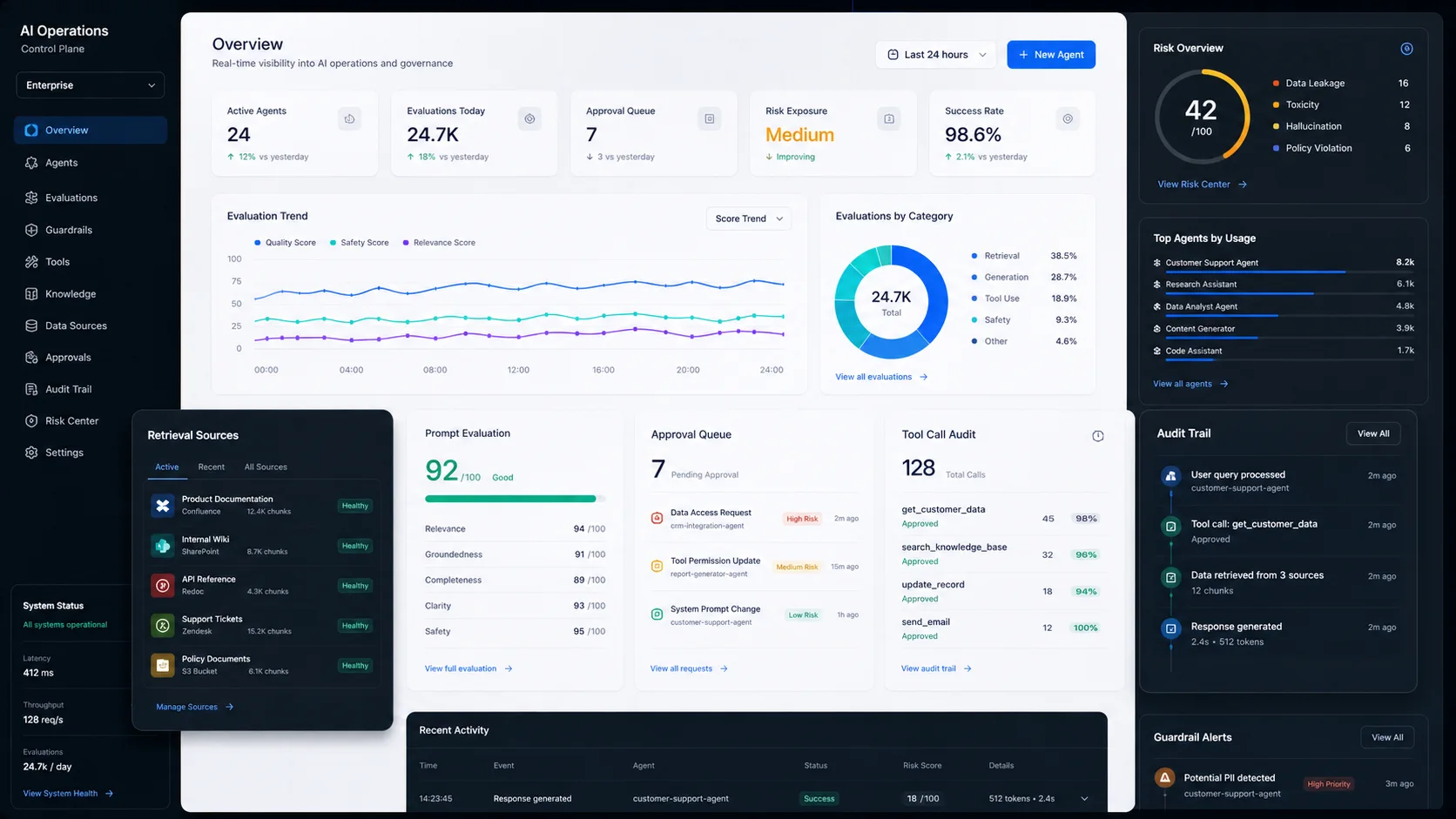
The selected representative workflow remains visible throughout the interaction.
Stages communicate what the demonstration is simulating or attempting.
Public-safe guidance and production distinctions are not hidden after launch.
05 · Production boundary
Enterprise work separately addresses source authority, identity, security, evaluation data, integrations, service ownership, incident response, and change control.
Define the actual workflow, consequence, users, decisions, and prohibited behavior.
Build representative cases and thresholds with accountable domain reviewers.
Design enterprise identity, data, controls, operations, and release evidence for the context.
A lab result is a learning artifact, not a production recommendation. Production work starts with a separate risk, data, evaluation, and ownership review.
Open the experiments