Use synthetic context
Describe a fictional or generic scenario with no identifying customer or employee detail.
Sense Labs · Experiments
The experiment below illustrates several enterprise interaction patterns without customer data or operational access. Use generic, non-confidential text and evaluate the workflow cues, not the output as professional advice.
01 · Use conditions
The experiment is intended for generic exploration. It cannot understand your organisation's authority model, source truth, policies, or operational conditions.
Describe a fictional or generic scenario with no identifying customer or employee detail.
Treat claims, references, and recommendations as unverified until checked independently.
Do not use the result for legal, medical, financial, security, employment, or operational decisions.
02 · Interactive lab
The workbench demonstrates interaction patterns in a bounded public environment. Modes are not production integrations or claims of customer-specific capability.
03 · Interpretation
Workflow stages, mode selection, and source cues demonstrate interface concepts. They do not establish factual correctness, permission enforcement, production availability, or fitness for a real workflow.
Interaction flow, public guardrail language, stage progression, and a generated response.
Customer source quality, enterprise access behavior, workflow acceptance, or service readiness.
Representative case results, control tests, operator exercises, and accountable approval.
04 · Workflow shape
The workbench visualises context, processing stages, output, and safety cues. In enterprise delivery, each of those surfaces is connected to real evidence and ownership.
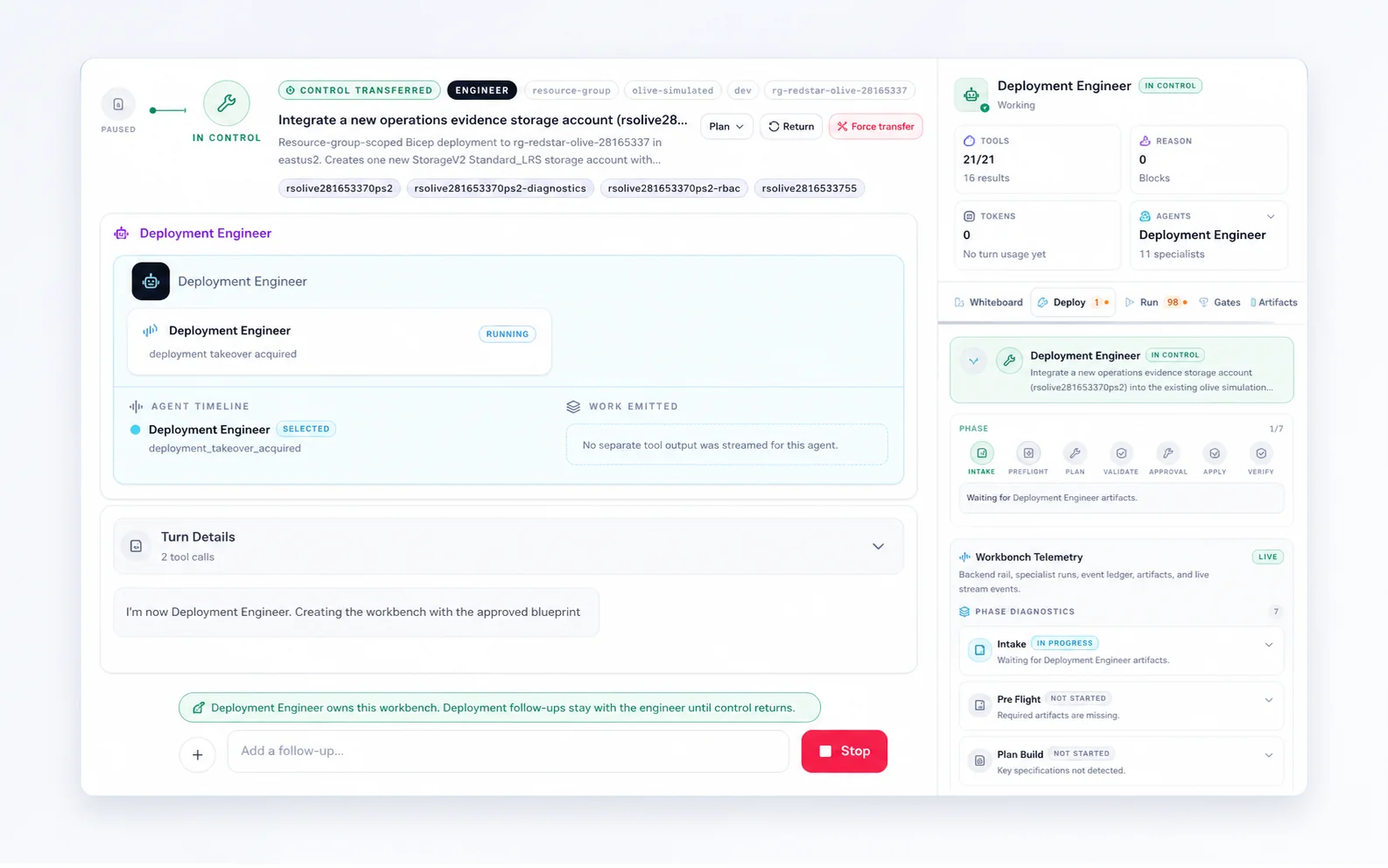
Production context needs approved sources, identity, freshness, and provenance.
Production stages need contracts, telemetry, timeouts, and recovery behavior.
Production output needs task-specific evaluation, review, and incident handling.
05 · Production boundary
Capture the workflow, evidence, users, actions, failure consequences, and review duties that the public experiment cannot represent. Those become inputs to an enterprise assessment.
What task or judgment would the real workflow support, and who remains accountable?
Which sources are authoritative, permitted, current, and available for representative testing?
When must the system refuse, defer, escalate, pause, or return control to a person?
A lab result is a learning artifact, not a production recommendation. Production work starts with a separate risk, data, evaluation, and ownership review.
Start the experiment