Connect demand, materials, work, inspection and finished stock. Manufacturing & Quality supports bills of materials, production planning, work orders, job cards, material movement, subcontracting, inspection and production-cost visibility.
BOM and routingProduction planningWork orders and job cardsInspection and traceability
Demand translated into material and production requirementsVisible progress by work order, operation and workstationTraceable material movement through WIP and finished goodsInspection and non-conformance context linked to the relevant transaction
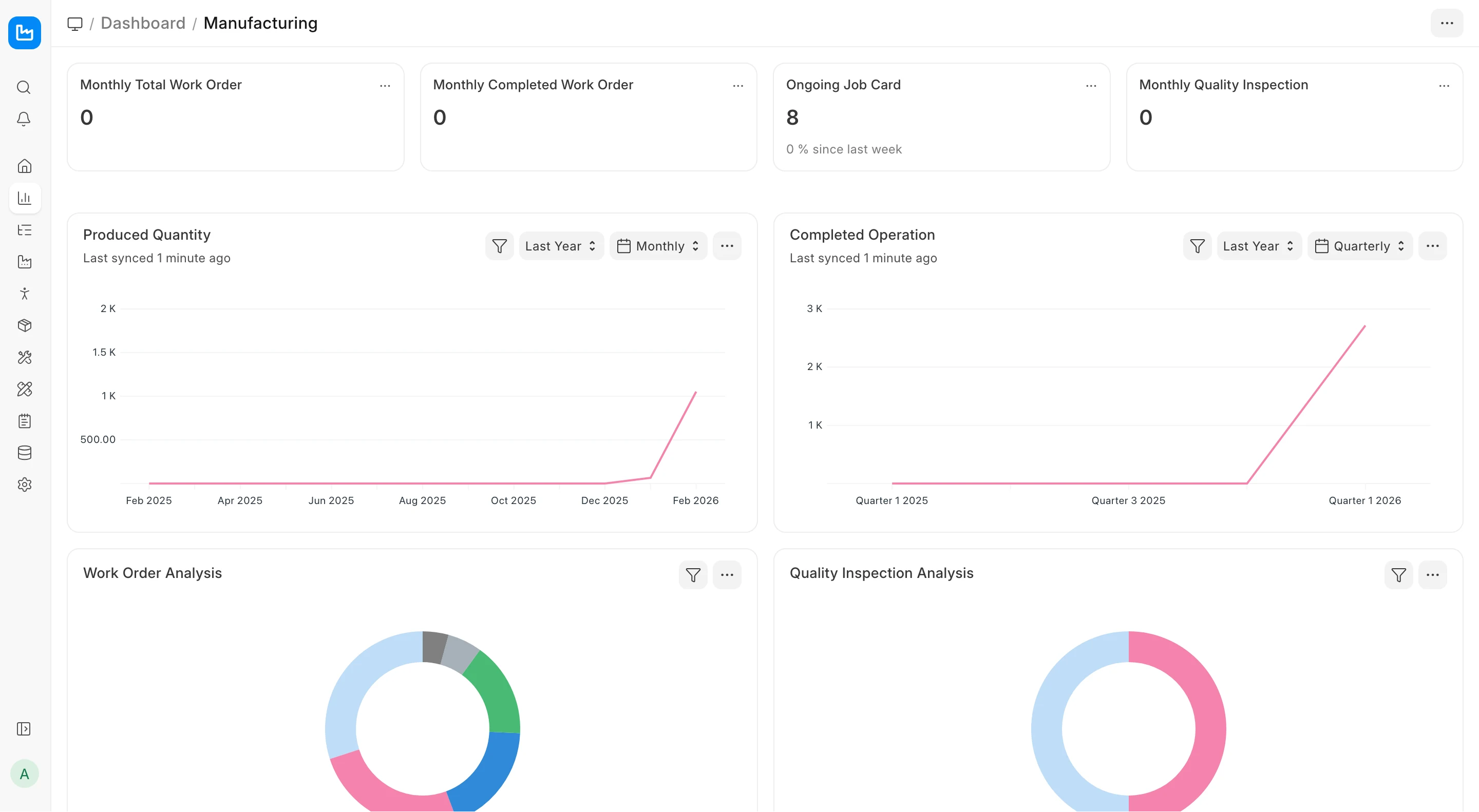
Actual application interface from the official module documentation; final configuration and scope are confirmed per deployment.
Manufacturing applicationManufacturing dashboard
Actual application interface from the official documentation. View source · CC BY-SA.
01Demand
02Material plan
03Work order
04Job cards
05Inspection
06Finished stock
Working coverage
Capability where the transaction and responsibility meet.
Discrete and mixed-mode manufacturers that need a practical link between commercial demand, material availability, shop-floor execution and accounting.
Engineering foundation
Define what is made, how it is made and the material and operation assumptions behind cost.
Item and variant masters
Single and multi-level BOM
Operations and routing
Workstations and rates
Alternative items
BOM comparison and revision controls
Planning and materials
Turn demand into feasible production and supply actions.
Production plan
Sales-order or material-request demand
Sub-assembly planning
Work-order creation
Purchase and material requests
Planned start and delivery dates
Execution
Record work, time, quantity, WIP movement and completion at the responsible operation.
Work orders
Job cards
Employee and workstation assignment
Material transfer to WIP
Consumed and completed quantity
Scrap, process loss and finished goods
Quality
Apply agreed inspection parameters at incoming, in-process or outgoing stages.
Quality inspection templates
Incoming inspection
In-process inspection
Final or outgoing inspection
Accepted and rejected result
Quality action and review context
Subcontracting and supply
Maintain the relationship between supplied material, subcontract work, receipt and accepted outcome.
Subcontract purchase order
Material supplied to subcontractor
Subcontracting receipt
Consumed components
Returned or excess material
Supplier and quality context
Cost and performance
Compare planned and recorded material, time and operating cost with production progress.
Planned and actual operation time
Workstation operating cost
Material consumption
Production progress
WIP and finished value
Manufacturing reports
End-to-end flow
A controlled path from plan to accepted production
Planning, shop-floor recording, stock movement and inspection remain connected to the work order and its demand source.
01
Plan
Consolidate demand, BOMs, sub-assemblies and required supply actions.
Production planning02
Release
Create authorised work orders and confirm materials, operations and schedule.
Production control03
Issue and execute
Move materials, run job cards and record time, completed quantity, pending work and loss.
Stores and shop floor04
Inspect
Record the applicable quality checks and hold rejected or incomplete outcomes for review.
Quality05
Receive and review
Post accepted finished goods and compare plan, actual usage, time and cost.
Production and finance
Role views
The same process. Different working context.
Each person sees the queues, measures, records and actions that belong to their responsibility.
01
Production planner
Demand and feasibility
Production plansMaterial gapsCapacityRelease queue
Material varianceOperation costWIP valueCompleted production
Controls retained in the flow
Approved BOM and routing
Work-order status
Warehouse and WIP permissions
Inspection requirement
Rejected or incomplete quantity
Return and correction records
Configured for the operating model
Items and variants
BOMs and operations
Workstations and calendars
Manufacturing warehouses
Quality parameters
Subcontracting flows
Capacity models, process-manufacturing needs, machine connectivity, sector-specific quality standards and advanced planning requirements are qualified before scope is confirmed.
Connected applications
Continue the operating cycle.
Move into the responsibilities that sit immediately before, after or alongside this application.
Sense ERP solutions may use and extend established open-source business platforms, including the ERPNext and Frappe ecosystem, alongside Swaves configuration, integration and managed services. Capabilities and interface patterns shown here are referenced against current published module documentation. ERPNext and Frappe are trademarks of their respective owner. Swaves does not claim partner certification, endorsement or ownership of upstream products.
Current companies, sites and systemsUsers, roles and approval authorityPriority process and known exceptionsMigration, statutory and integration requirements